
Homeopathy in History
Washington Irving
Writer. Historian. Diplomat.
An Unexpected Believer in the Medicine That Helped Him.
Washington Irving (1783–1859), author of Rip Van Winkle and The Legend of Sleepy Hollow, became one of the first American writers to achieve genuine international literary recognition. Less well known is the story preserved in his own correspondence about his experience with homeopathy.
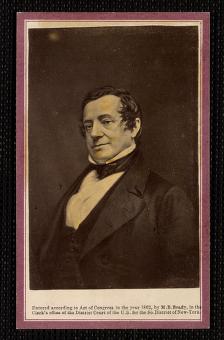
Washington Irving’s connection with homeopathy does not depend upon a quotation attributed to him generations later. His own letters survive—and so does the medical account of the physician who treated him.
Few names are more closely associated with early American literature. Irving’s Sketch Book of Geoffrey Crayon, Gent., published in 1819–1820, introduced readers on both sides of the Atlantic to stories that would become enduring pieces of American culture.
But Irving’s career extended well beyond fiction. He wrote substantial historical and biographical works, including books about Christopher Columbus and George Washington, traveled extensively in Europe, and represented the United States abroad. From 1842 to 1846, Irving served as United States Minister to Spain.
During the final decade of his life, Irving also received homeopathic medical care.
Rather than relying upon later accounts of Irving’s relationship with homeopathy, I returned to two nineteenth-century sources: Irving’s published correspondence and the medical account written by his treating physician, Dr. John C. Peters. Read together, they allow the story to be reconstructed in remarkable detail.
The Physician’s Account
A Medical Relationship
That Lasted More Than
Seven Years
By the early 1850s, Irving was approaching seventy and living at Sunnyside, his beloved home overlooking the Hudson River near Tarrytown, New York.
He was still intensely engaged in literary work and had begun one of the largest projects of his career: the multivolume biography that would become his Life of George Washington.
In February 1852, Irving and his family came under the care of Dr. John C. Peters, a New York physician closely associated with nineteenth-century homeopathy and later an editor of the North American Journal of Homoeopathy.
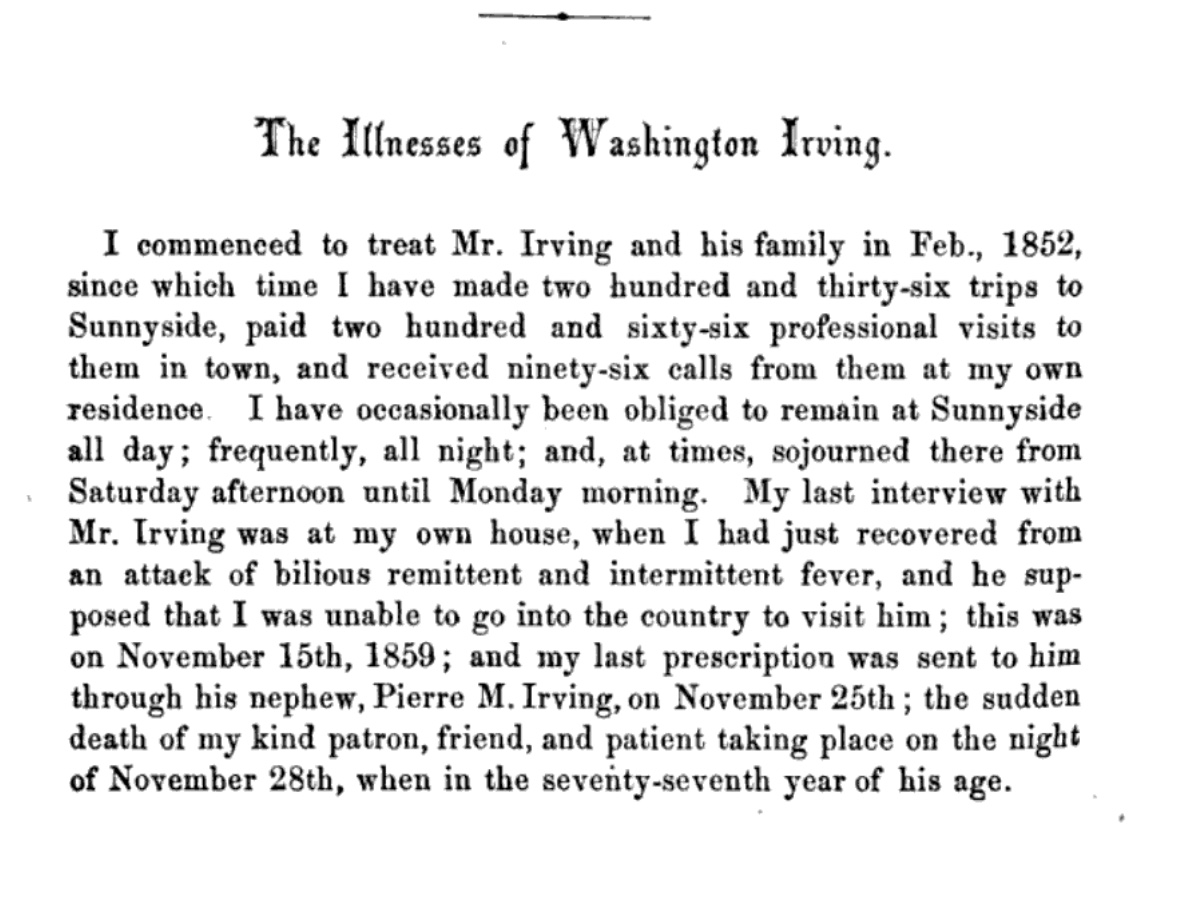
After Irving’s death, Peters published his own account, The Illnesses of Washington Irving.
“I commenced to treat Mr. Irving and his family in Feb., 1852…”
Dr. Peters reported that during the years that followed he made 236 trips to Sunnyside, paid 266 professional visits to the family in town, and received 96 calls from them at his own residence.
At times, Peters remained at Sunnyside all day. Frequently, he stayed through the night. On some occasions he remained from Saturday afternoon until Monday morning.
His last personal interview with Irving occurred on November 15, 1859. His last prescription was sent through Irving’s nephew, Pierre M. Irving, on November 25. Although Irving had endured a prolonged and complicated illness, his final months brought a remarkable period of relief. His asthma and cough subsided, his strength and appetite improved, and his nights became less troubled. Less than six weeks before his death, he told his nephew Pierre, “I feel that I am growing stronger and better.” Irving died suddenly on November 28, 1859. In a letter written afterward, Pierre thanked Dr. Peters for his devoted care and attributed his uncle’s “partial improvement and comparative comfort” during those final months to Dr. Peters’s treatment.
1852
Vertigo, an Overtaxed Mind—and Cocculus
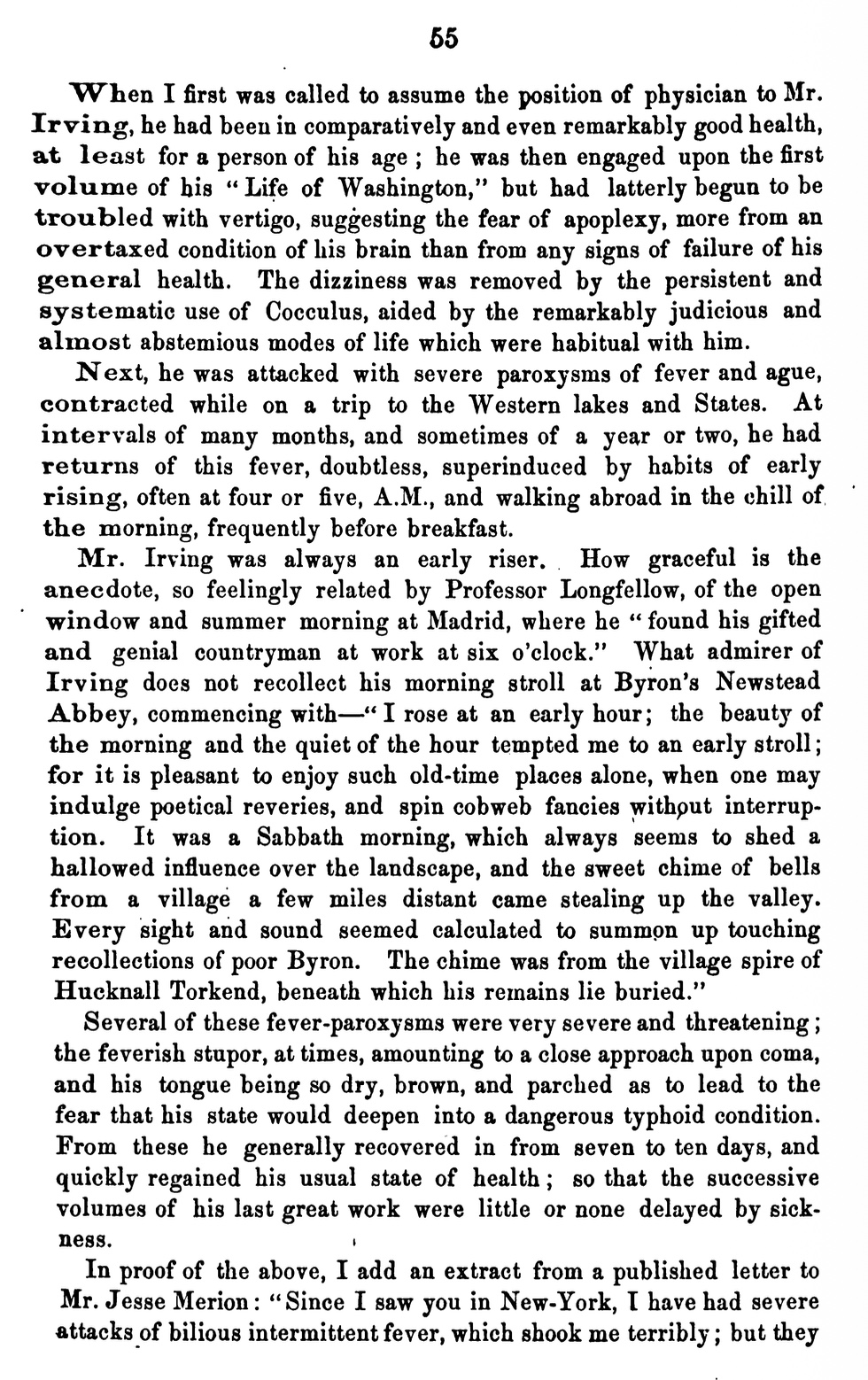
Peters tells us what was happening when he first became Irving’s physician.
Irving was working on the first volume of his Life of Washington when he began suffering from vertigo.
Peters described Irving as very healthy for someone in his late 60's, but wrote that he had “latterly begun to be troubled with vertigo.”
The symptoms appeared to mimic stroke but Dr. Peters realized the intense work Irving was doing caused an “overtaxed condition of his brain” instead of his health actually declining.
Peters then identified the remedy and the result he observed.
“The dizziness was removed by the persistent and systematic use of Cocculus…”
Peters also credited Irving’s disciplined lifestyle with helping his recovery.
The record is unusually specific: we know the physician, the complaint, the remedy, and the outcome Peters reported.
But the story becomes even more interesting when Peters’s account is placed beside Washington Irving’s own private correspondence.
Irving in His Own Words
“I Have Found, in My Own Case, Great Relief from Homoeopathy”
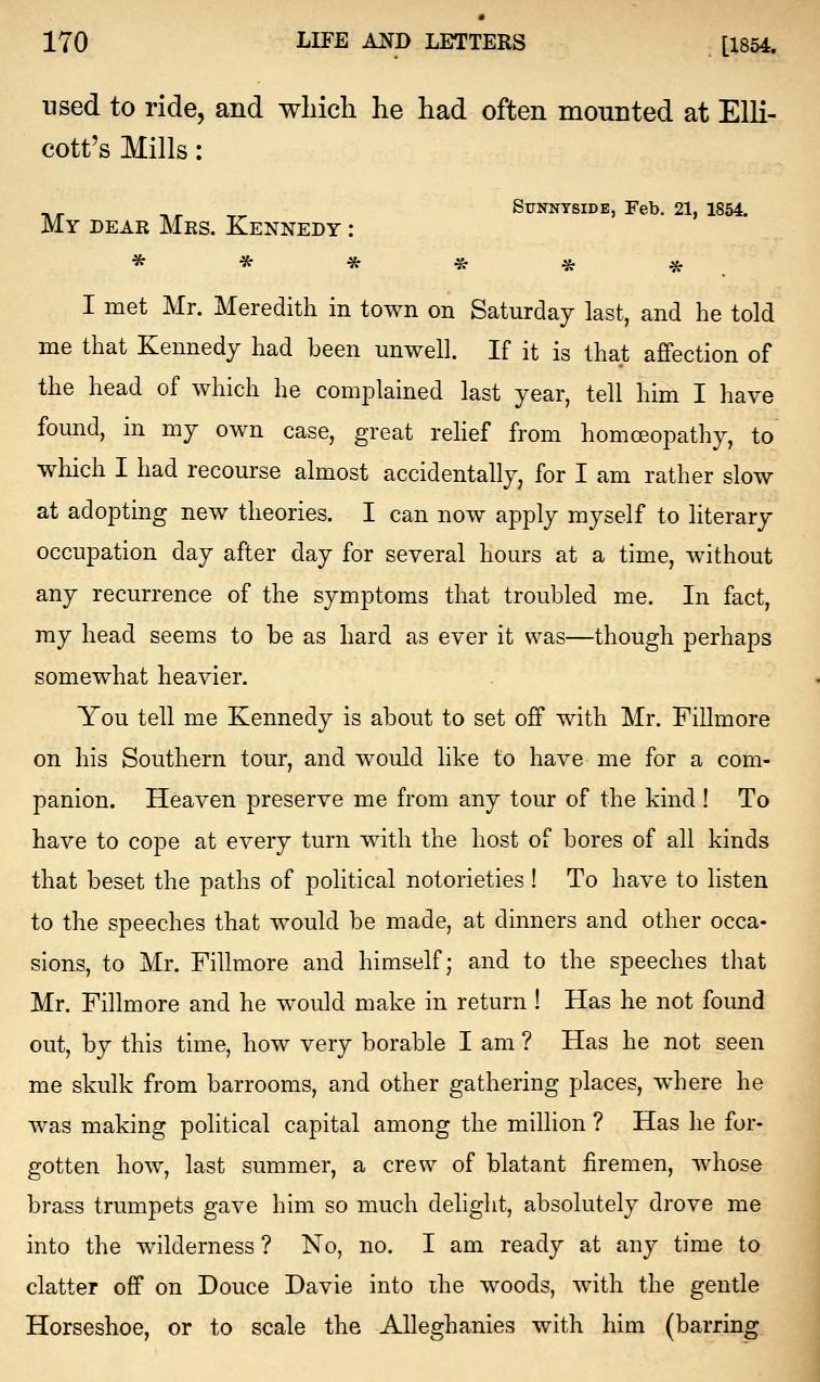
On February 21, 1854, Irving wrote from Sunnyside to his friend Mrs. Kennedy.
Her husband had an illness affecting his head. Irving responded by describing his own experience.
“I have found, in my own case, great relief from homoeopathy, to which I had recourse almost accidentally, for I am rather slow at adopting new theories.”
This final admission gives the passage much of its historical significance.
Irving did not portray himself as someone eager to embrace a new medical system.
Quite the opposite.
He was, in his own words, “rather slow at adopting new theories.”
Yet his personal experience had apparently challenged his caution.
“I can now apply myself to literary occupation day after day for several hours at a time, without any recurrence of the symptoms that troubled me.”
For Irving, that was no small measure of improvement. Writing was one of the central activities of his life, and the symptoms had interfered with his ability to do so.
Because of homeopathy, he could now return to what he had spent a lifetime doing: writing.
Reading the Sources Carefully
Were Irving and Peters
Describing the Same Complaint?
Peters’s medical account and Irving’s private correspondence fit together remarkably well, but historical sources should not be made to say more than they actually do.
Peters describes vertigo present when he assumed Irving’s care and reports treating the dizziness with Cocculus.
Irving’s letters from 1854 instead call his problem an “affection of the head” and a “complaint of the head.”
In his August letter, Irving specifically says that this complaint had troubled him during the previous year—1853.
Six Months Later
“I Really Begin to Have Great Faith in Them”
Fortunately, Irving’s correspondence allows us to follow the story beyond a single report of improvement.
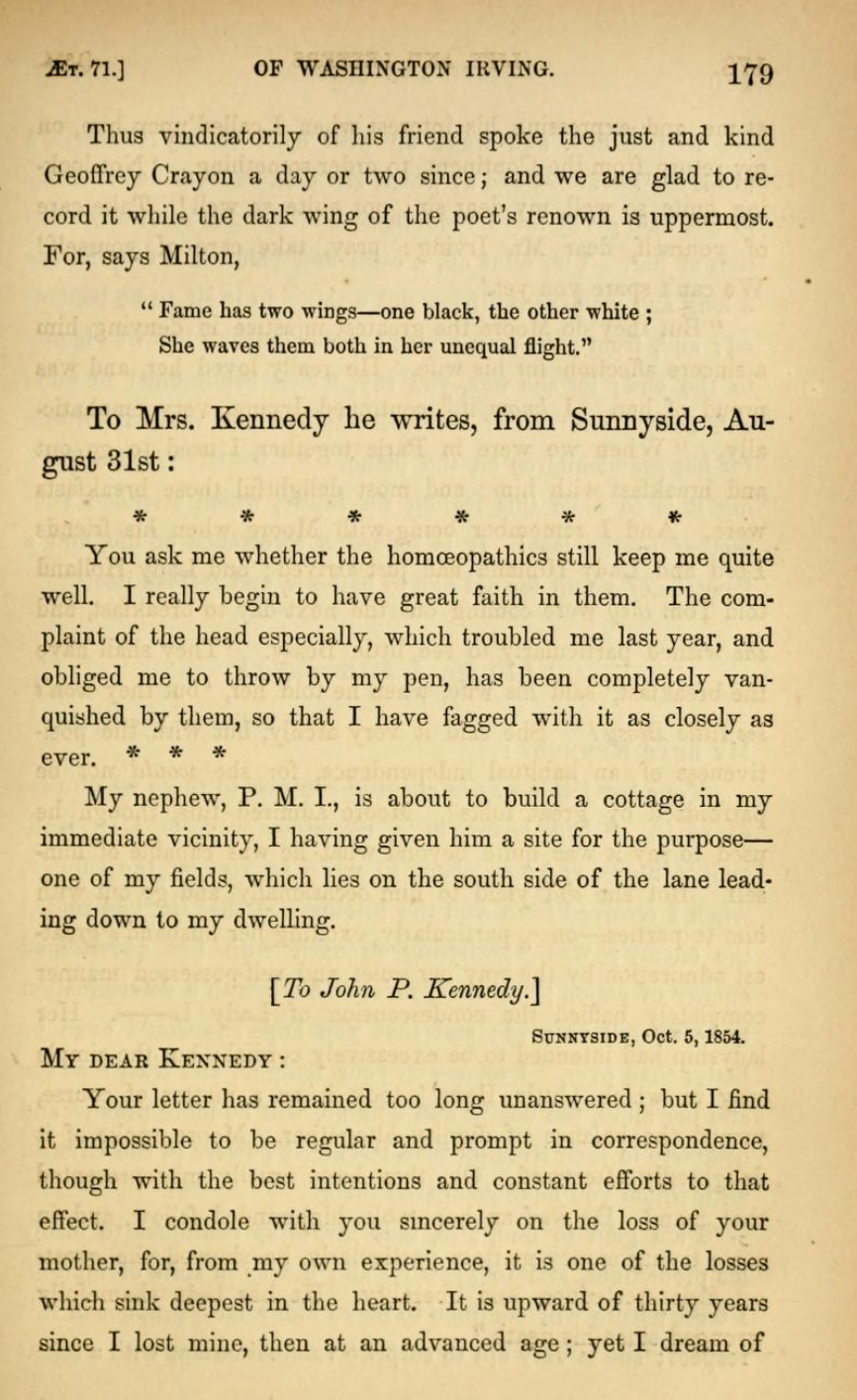
On August 31, 1854, Mrs. Kennedy asked Irving if he was still using homeopathy.
His answer was considerably more enthusiastic.
“I really begin to have great faith in them.”
Irving then returned specifically to the complaint that had interfered with his writing.
“The complaint of the head especially, which troubled me last year, and obliged me to throw by my pen, has been completely vanquished by them…”
The progression preserved in these two letters is striking.
February 1854:
I was slow to adopt new theories, but I have found great relief from homeopathy.
August 1854:
I really begin to have great faith in them.
We can actually watch Irving’s opinion change through his own correspondence.
A Relationship That Continued
“Those Powders Which
Proved So Efficacious Before”
Irving’s relationship with Peters did not end with the letters from 1854.
Peters’s medical account reproduces several letters he received directly from Irving.
Before Peters departed for Europe in June 1857, Irving wrote:
“I wish, before you embark on your short trip to Europe, you will have put up for me a few of those powders which proved so efficacious before.”
Irving then invited Peters to Sunnyside and jokingly told him that he expected Dr. Peters to make everyone in his house so healthy that they would not have any illnesses while he was away.
Peters printed this correspondence while discussing another illness for which he had treated Irving: a longstanding eruptive irritation around the ankles.
Peters reported treating the condition not with salves but through the “somewhat persistent use of Hepar-sulphur,” after which he said Irving recovered from it beautifully for the rest of his life.
The surviving 1857 letter itself does not identify what medicine was contained in the “powders.” We therefore should not assume they were necessarily Hepar sulphur—or Cocculus, but homeopathaic remedies are often given in a powder form even today.
Irving’s statement requires no embellishment.
He was requesting medicines from Peters because earlier powders the physician had supplied had, in Irving’s own words, “proved so efficacious before.”
Physician and Patient
Irving’s Confidence in Dr. Peters
The surviving record also reveals how much confidence Irving came to place in his physician.
Shortly before beginning The Illnesses of Washington Irving, Peters wrote that Irving had developed the habit of “always relying solely upon me for medical advice,” despite more than twenty miles separating them.
Peters reproduced another note from Irving in which the writer asked him to attend a visiting friend suffering from a severe cold and the man’s daughter, who had a sore throat.
Irving playfully asked Peters to “make them both well, as I told them you would do immediately.”
The wording should not be read as a literal guarantee of medical success. But as personal correspondence, it illustrates the familiarity and confidence that had developed between physician and patient.
Peters eventually referred to Irving as his “kind patron, friend, and patient.”
Historical Perspective
From Caution to Confidence
Washington Irving’s story is valuable precisely because it does not need embellishment.
There is no evidence that Irving became a homeopath, studied homeopathy, or became a public spokesman for the profession.
The historical evidence tells a simpler—and arguably more compelling—story.
Peters records treating Irving’s vertigo with Cocculus and reports that the dizziness was removed.
Irving reports “great relief from homoeopathy” and says he can again work for hours without recurrence of the symptoms that troubled him.
Irving says, “I really begin to have great faith in them,” and describes his head complaint as “completely vanquished.”
Irving asks Peters for additional powders because previous ones had “proved so efficacious before.”
That is not evidence of a passing curiosity.
It is evidence of a patient’s developing confidence based upon what he had experienced.
Two Sides of the Historical Record
The Patient’s Testimony and the Physician’s Account
Washington Irving belongs among the stronger documentary examples in the Homeopathy in History collection because his story can be reconstructed from two complementary nineteenth-century sources.
The first preserves Irving’s own correspondence.
His nephew and biographer, Pierre M. Irving, published The Life and Letters of Washington Irving. Volume IV, published by G. P. Putnam in New York in 1864, contains both of Irving’s 1854 letters to Mrs. Kennedy.
“I have found, in my own case, great relief from homoeopathy…”
“I really begin to have great faith in them.”
These are not statements attributed to Irving by a twentieth- or twenty-first-century writer.
They are Irving’s correspondence, published only a few years after his death.
The second source gives us the physician’s side of the story.
In 1860, John C. Peters published A Review of Some of the Late Reforms in Pathology and Therapeutics: With an Appendix on the Illnesses of Washington Irving.
There Peters records beginning his treatment of Irving and his family in February 1852, describes Irving’s vertigo, identifies Cocculus, and reports that “the dizziness was removed.”
Peters’s account appeared in 1860, only months after Irving’s death on November 28, 1859.
Together, these sources give us something unusually valuable: the patient’s testimony and the treating physician’s account.
Why Washington Irving’s Story Matters
His Experience, Preserved in His Own Words
Irving lived through an extraordinary period in American medicine. Homeopathy arrived in the United States during his lifetime and expanded rapidly during the nineteenth century, developing physicians, pharmacies, professional societies, medical colleges, and hospitals.
Irving’s correspondence allows us to glimpse that medical world not through institutional statistics or professional arguments, but through the experience of an individual patient.
And that patient happened to be one of the foundational figures of American literature.
More than three decades before these events, Irving’s imagination had given American culture Rip Van Winkle and The Legend of Sleepy Hollow.
By the time John C. Peters became his physician in 1852, Irving was an older man working on an entirely different kind of legacy: his monumental biography of George Washington.
He did not accept it immediately.
He tried it.
He observed what happened.
And then he wrote about the result.
Perhaps no sentence captures Washington Irving’s place in the history of homeopathy better than the one he wrote privately from Sunnyside on February 21, 1854:
“I have found, in my own case, great relief from homoeopathy…”
Not legend.
Not a quotation attributed to him generations later.
His experience, preserved in his own correspondence—and accompanied by the surviving account of the physician who treated him.
Primary Sources
Explore the Historical Record
Further Reading
The following secondary sources offer additional discussion of Washington Irving’s relationship with homeopathy and its place within the broader history of the profession.