
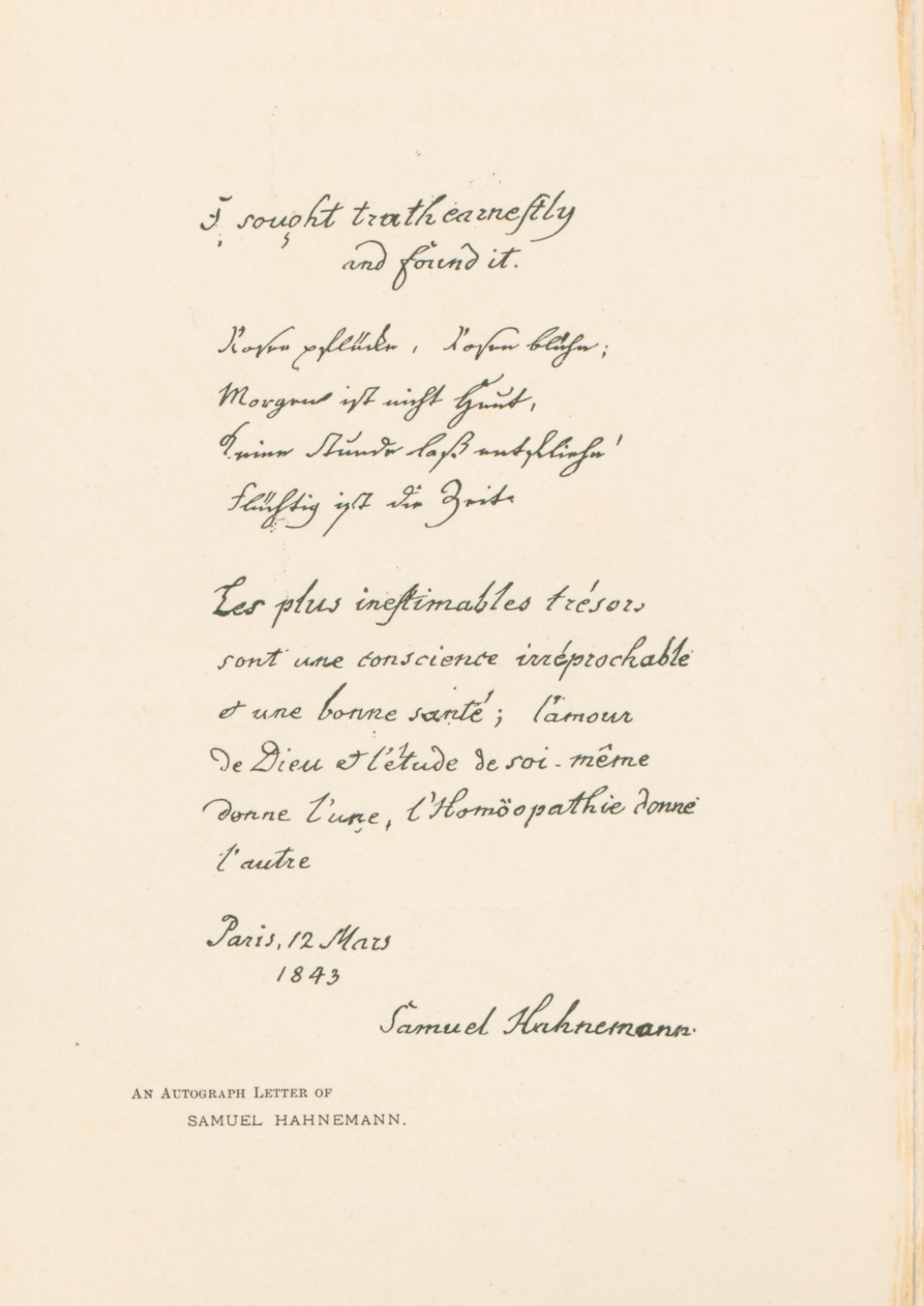
Reproduced fromThe Homœopathic Physician: Journal of Medical Science, April 11, 1895.
The Search for Truth
Questions are welcomed.
“I sought truth earnestly and found it.”
Samuel Hahnemann
Classical homeopathy was shaped through careful observation, rigorous questioning, and a lifelong search for truth. Whether you are completely new to homeopathy, thoughtfully skeptical, or simply curious to learn more, your questions are an important part of the journey.
Foundational Questions
What is classical homeopathy?
Classical homeopathy is an individualized system of medicine centered on careful observation and the complete symptom picture of the person. These questions explore the principles that distinguish classical homeopathy from other approaches to health and wellness.
What is classical homeopathy?
Classical Homeopathy is an individualized system of medicine founded by the German physician Dr. Samuel Hahnemann. Rather than treating a diagnosis alone, Classical Homeopathy considers the complete picture of a person’s physical, mental, and emotional symptoms to select a single remedy uniquely matched to the individual. Homeopathy is used by more than 200 million people worldwide and is practiced in over 100 countries, making it one of the world’s most widely used systems of healthcare.
Classical Homeopathy is founded on the Law of Similars, expressed in the Latin phrase similia similibus curentur—“let like be cured by like.” Through careful observation and experimentation, Hahnemann realized that a substance capable of producing symptoms in a healthy person could stimulate healing in someone experiencing a similar pattern of symptoms.
He coined the term homeopathy, derived from the Greek words homoios (“similar”) and pathos (“suffering”), in his early writings on the subject before he wrote the first edition of Organon of the Rational Art of Healing.
Today, Classical Homeopathy continues to follow the principles first laid out by Hahnemann over two centuries ago, emphasizing careful observation, individualized treatment, and respect for the body’s natural capacity to restore health.
Who was Samuel Hahnemann?
Dr. Samuel Hahnemann (1755-1843) was a physician, chemist, linguist, translator, and one of the foremost medical scholars of the Enlightenment. Fluent in numerous languages (some sources credit him with proficiency in as many as fifteen), he translated many of Europe’s leading scientific and medical works, giving him an unusually broad understanding of both ancient and contemporary medicine.
Increasingly dissatisfied with the often harmful medical practices of his day, Hahnemann stepped away from conventional practice and supported himself through translation while devoting his life to careful observation, experimentation, and scientific inquiry. In 1790, while translating William Cullen’s A Treaties of the Materia Medica, he questioned why cinchona bark successfully treated malaria. Rather than accept the prevailing explanation, he tested the bark on himself. Although he was healthy, repeated doses of cinchona produced symptoms strikingly similar to those of malaria. This experiment became the foundation for Hahnemann’s recognition of the therapeutic principle later known as the Law of Similars.
Hahnemann did not claim to invent this principle. Instead, he believed he had recognized a natural law that earlier physicians, including Hippocrates, had occasionally observed but never fully developed into a complete system of medicine.
His life’s work culminated in the Organon of Medicine, the foundational text of Classical Homeopathy that continues to guide practitioners today.
Samuel Hahnemann was a true medical reformer—an Enlightenment scholar whose mastery of languages, commitment to careful observation, and broad scientific learning enabled him to challenge conventional medicine and develop the principles of Classical Homeopathy.
Why might two people with the same diagnosis receive different remedies?
A diagnosis describes a condition, but it does not always describe the unique way that condition is experienced. One person may feel better from warmth while another prefers cold. One may become restless, while another wants quiet and solitude. One person’s symptoms may be worse at night, while another’s appear in the morning.
Those individualizing details help distinguish one case from another.
What does “one remedy at a time” mean?
In Classical Homeopathy, one carefully selected remedy is generally given at a time. This allows the response to be observed clearly without introducing several remedies simultaneously.
The remedy may then be repeated, adjusted, changed, or simply allowed more time depending on the individual’s response.
How is homeopathy different from herbal medicine or supplements?
Homeopathy, herbal medicine, and nutritional supplementation are distinct approaches. Herbal products generally contain measurable plant constituents, while supplements provide nutrients or other substances in material doses.
Homeopathic remedies are prepared through a specialized process of serial dilution and succussion and are selected according to the individualized symptom picture.
Why is classical homeopathy considered holistic?
Classical Homeopathy considers the person as an integrated whole. Physical symptoms are important, but they are considered together with sleep, energy, appetite, temperature preferences, emotional responses, personal tendencies, and many other characteristic details of a person.
The goal is to understand the relationship among the symptoms rather than viewing each one as an isolated event.
Homeopathic Pharmacy
Understanding the remedies
Homeopathic remedies have a history, language, and method of preparation that may be unfamiliar at first. These questions explain where remedies originate, how they are prepared, and how their use is individualized.
What are homeopathic remedies made from?
Homeopathic remedies originate from substances found in the mineral, plant, or animal kingdoms.
These source materials are prepared according to the standards of the Homeopathic Pharmacopoeia of the United States (HPUS), the official compendium recognized by the U.S. Food and Drug Administration (FDA) for homeopathic medicines.
How are homeopathic remedies prepared?
Homeopathic remedies are prepared through a process of serial dilution followed by a specialized form of vigorous shaking known as succussion.
This method transforms the original substance into a homeopathic remedy. In lower potencies, minute amounts of the original substance may remain, while higher potencies may contain no measurable molecules of the original source material. According to the principles of classical homeopathy, the healing properties of the remedy are intensified through this preparation process rather than by the quantity of the original substance present.
When a remedy is carefully matched to an individual's unique symptom picture, it is understood to stimulate the body's inherent capacity to restore balance and health. The sequence and scale of preparation are represented by the potency printed on the remedy label, such as 12C,30C, 200C, LM3 and many more.
Why are homeopathic pellets so small?
The small pellets act as carriers for the prepared homeopathic remedy. The size of the pellet does not determine the selected potency or the appropriateness of the remedy for an individual case.
How should remedies be stored?
Remedies are generally stored in their original containers in a cool, dry place away from direct sunlight, strong odors, excessive heat, and moisture. It is also good practice to store remedies away from energy sources like computers and microwaves. If your remedy is liquid, refrigeration also helps. Follow all guidelines given by the manufacturer.
Why are remedies not always taken every day?
The timing and repetition of a remedy depend on the individual case, the potency, the nature of the concern, and the response being observed. In some situations a remedy may be repeated; in others, a single dose may be followed by a period of careful observation. This is where a classically trained homeopath excels; understanding your remedy reactions are done carefully and intentionally. Detailed communication at follow up appointments contributes to well selected next steps in dosing recommendations.
Children & Families
Homeopathy across the stages of life
Individualized homeopathic care considers each person’s complete symptom picture, whether the client is an infant, child, adolescent, or adult.
Can children receive individualized homeopathic care?
Yes, children are wonderful clients. A parent or legal guardian participates in the consultation and provides health history, observations, and information about the child’s symptoms and general tendencies. However, as a rule of thumb the older the child is the more I want to hear their story in their own words.
Can infants receive homeopathic care?
Infants may also be considered for individualized homeopathic care. Because infants cannot describe their experiences verbally, the observations of parents and caregivers become especially important.
Can several members of one family receive care?
Yes. Each family member is considered as a separate, individualized case. Even relatives who share similar concerns may express their symptoms differently and may therefore require different remedies.
Do children receive the same remedies as adults?
A remedy is selected according to the individual symptom picture rather than age alone. Children and adults may sometimes receive the same remedy, but only when it appropriately corresponds to the individual case.
Still Have Questions?
Your questions are welcome.
Every person’s health story is unique. Whether you are exploring classical homeopathy for the first time or are ready to begin your own journey, I invite you to continue learning or reach out with your questions.