

From Teacher to Missionary
Mother Teresa was born Anjezë Gonxhe Bojaxhiu in Skopje on August 26, 1910. At eighteen, she left home to join the Sisters of Loreto and soon traveled to India. She arrived in Calcutta in January 1929 and eventually became a teacher and then principal at St. Mary’s school.
Her life changed dramatically after September 10, 1946, when, during a train journey to Darjeeling, she experienced what she later called her “call within a call”—a conviction that she was being called to leave the convent and live among and serve “the poorest of the poor.”
Before beginning that work, Mother Teresa undertook a short period of medical training with the Medical Missionaries in Patna in 1948. She then returned to Calcutta, where she visited the sick, taught street children, and established a school and dispensary in the Motijhil slums.
On October 7, 1950, the Missionaries of Charity was officially established. Medical care quickly became an important part of its work. The Missionaries of Charity’s own history records the establishment of medical dispensaries, a home for the dying in 1952, a home for abandoned children in 1955, and a mobile leprosy clinic in 1957.
A Homeopathic Dispensary in Calcutta
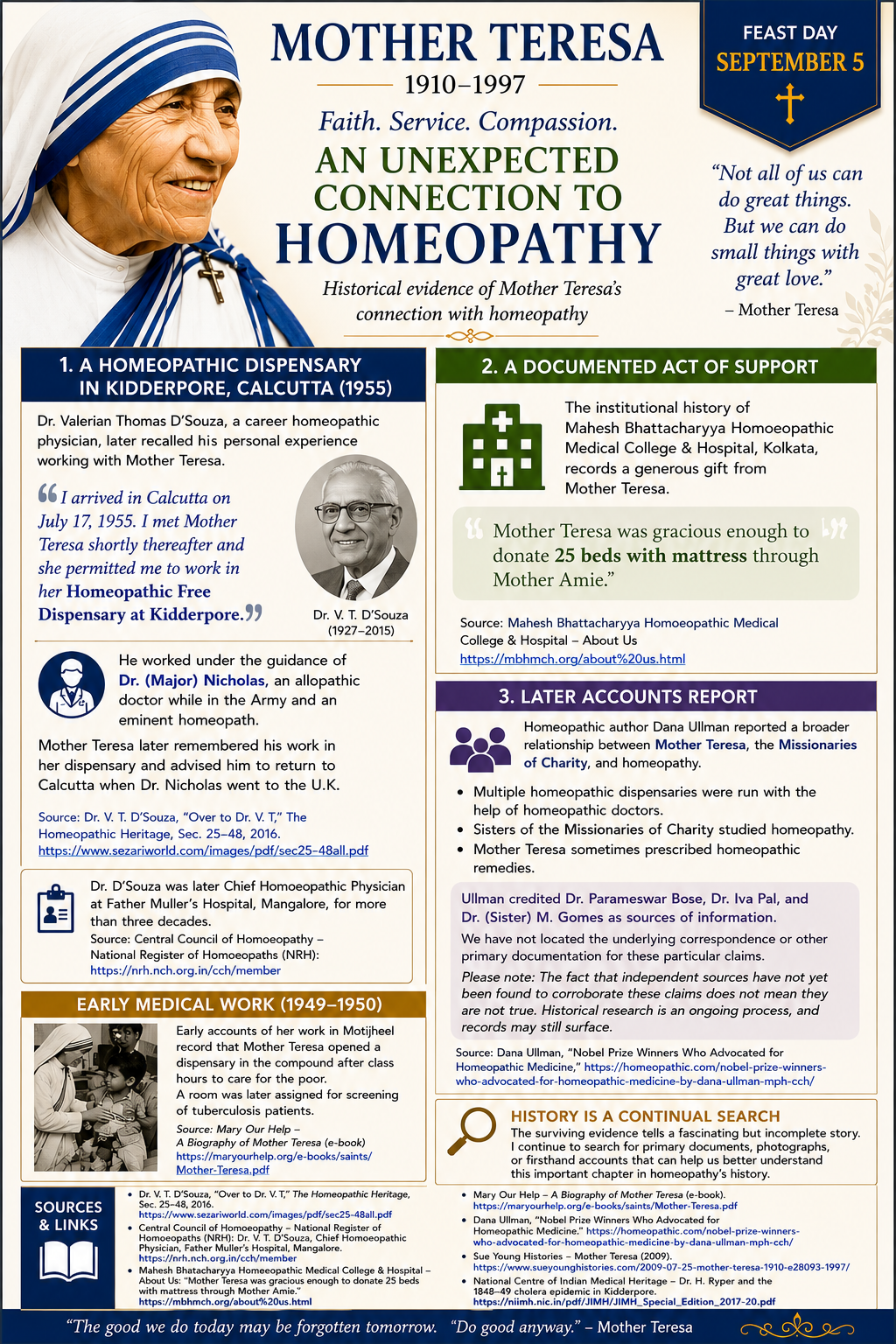
One of the most intriguing accounts comes from Dr. Valerian Thomas D’Souza, a career homeopathic physician who later served for decades as Chief Homoeopathic Physician at Father Muller’s Hospital in Mangalore.
Writing about his early life, D’Souza recalled arriving in Calcutta on July 17, 1955 and meeting Mother Teresa shortly thereafter.
According to his firsthand recollection, Mother Teresa permitted him to work in her:
“Homeopathic Free Dispensary at Kidderpore.”
D’Souza recalled working there under Dr. (Major) Nicholas, whom he described as having practiced conventional medicine while serving in the Army before becoming an eminent homeopath.
D’Souza also remembered encountering Mother Teresa again later. According to his account, she remembered his previous work in the dispensary and encouraged him to return to Calcutta after Dr. Nicholas had gone to the United Kingdom.
This is significant because D’Souza’s account does not originate with the later writers who popularized the story of Mother Teresa and homeopathy. It represents the retrospective testimony of a physician who claimed to have personally worked in the dispensary in 1955.
As with any recollection published decades after an event, it should be identified as such. I have not yet located a surviving 1955 dispensary record naming D’Souza or Nicholas. Nevertheless, D’Souza’s professional identity and career can be independently established, making his testimony an important piece of the historical record.
A Documented Gift to a Homeopathic Hospital
Another connection comes from an entirely different source.
The institutional history of Mahesh Bhattacharyya Homoeopathic Medical College & Hospital in Howrah records Mother Teresa’s support for the hospital during its development.
The institution states:
“Mother Teresa was gracious enough to donate 25 beds with mattress through Mother Amie.”
The college had begun in 1967 and subsequently developed a charitable outpatient department, hospital facilities, and formal education in homeopathic medicine. Its history records Mother Teresa’s donation in the context of the hospital’s expansion.
Unlike some of the broader stories surrounding Mother Teresa and homeopathy, this claim comes directly from the recipient homeopathic institution’s own historical record.
Mahesh Bhattacharyya Homoeopathic Medical College & Hospital — Institutional History →
Did Mother Teresa Personally Practice Homeopathy?
This is where the historical record becomes less certain.
Homeopathy author Dana Ullman has reported a substantially deeper relationship between Mother Teresa, the Missionaries of Charity, and homeopathy. His account describes multiple charitable homeopathic dispensaries, Sisters studying homeopathy, and Mother Teresa herself sometimes prescribing remedies.
Importantly, Ullman identifies individuals from whom he obtained information, specifically thanking Dr. Parameswar Bose and Dr. Iva Pal. Other versions of this historical account also identify Dr. (Sister) M. Gomes as a reference.
Dana Ullman — Mother Teresa and Homeopathy →
These reports deserve to be preserved as part of the historical trail. However, during my research I have not yet located the original correspondence, interviews, Missionaries of Charity records, or other primary documentation necessary to independently verify these particular claims.
That distinction is important.
It also does not mean the accounts are untrue. Historical records disappear, private correspondence remains inaccessible, memories are never written down, and many acts of ordinary charitable work leave little documentary trace. Ullman’s named sources may have possessed direct knowledge unavailable in public archives.
For that reason, I believe the most responsible approach is neither to present every reported detail as established fact nor to dismiss the accounts simply because I have not independently corroborated them.
They remain reported historical evidence worthy of further investigation.
What About Dr. Diwan Jai Chand?
Another frequently repeated story states that Mother Teresa learned homeopathy from the prominent Indian homeopathic physician Dr. Diwan Jai Chand (1887–1961) and encouraged Sisters to study it as well.
Jai Chand himself is not difficult to document. He was an important figure in twentieth-century Indian homeopathy, associated with homeopathic education, professional organizations, charitable medicine, and the journal Health and Homoeopathy.
What I have not found is a primary or contemporary source establishing that Mother Teresa personally studied with him.
I contacted the Central Council for Research in Homoeopathy (CCRH) in India while researching this question. Their library was unable to locate the material needed to establish the connection.
Therefore, at present I regard the Mother Teresa–Jai Chand relationship as an interesting but unverified historical claim, rather than an established fact.
What the Evidence Allows Us to Say
After following these different historical trails, I believe several distinctions are important.
Mother Teresa’s commitment to caring for the sick is exceptionally well documented. Her official biography records medical training in Patna before beginning her mission, and the Missionaries of Charity themselves document the establishment of dispensaries and other forms of medical care during the organization’s early years.
I also have Dr. V. T. D’Souza’s firsthand retrospective testimony that Mother Teresa permitted him to work in her Homeopathic Free Dispensary at Kidderpore in 1955.
Separately, a homeopathic medical college and hospital records Mother Teresa’s donation of 25 beds and mattresses to its hospital.
Beyond those points lies a larger collection of accounts describing a much deeper involvement with homeopathy. Those accounts may ultimately prove accurate, but some of their underlying documentation remains elusive.
History Is a Continual Search
One of the things I have come to appreciate while researching Homeopathy in History is that historical research rarely provides every answer at once.
Sometimes we find the original handwritten letter. Sometimes an institutional record preserves an unexpected detail. Sometimes a physician leaves behind a firsthand recollection decades later. And sometimes a story survives while the documents that could confirm it remain undiscovered.
Mother Teresa’s relationship with homeopathy appears to contain a little of each.
I will continue searching for letters, photographs, dispensary records, contemporary publications, and firsthand accounts that might help illuminate this fascinating chapter in the history of homeopathy.
What I can document already tells an intriguing story: a woman whose life’s work centered on bringing compassionate care to people who had very little, and historical evidence placing homeopathy within at least part of that work.
Sources & Further Reading
- Missionaries of Charity — Mother Teresa, Our Foundress
- Missionaries of Charity — History of the Missionaries of Charity
- Dr. V. T. D’Souza — published recollection inThe Homoeopathic Heritage
- Mahesh Bhattacharyya Homoeopathic Medical College & Hospital — Institutional History
- Dana Ullman — Mother Teresa and Homeopathy